

Education
Why Is Monday Called Monday And Not Tuesday? Origin, Mystery, And The Enigma Of The Week’s Beginning





Monday: The Enigma of the Week’s Beginning


Introduction
Monday, the first day of the week, holds a unique place in our calendar. Its name, steeped in ancient mythology and linguistic evolution, reveals a fascinating story passed down through centuries.
Table of Contents
The Mythological Origins of Monday
ORIGIN
The origins of the name “Monday” are shrouded in mystery, but its roots lie deep within ancient mythology. In many cultures, the days of the week were named after celestial bodies or deities, and Monday is no exception.
In Germanic mythology, Monday was associated with the Moon. The Old English word for Monday, “Monandæg,” translates to “Moon’s day.” This connection to the Moon is also evident in other languages, such as German (“Montag”) and Dutch (“Maandag”).
The Moon, in turn, was often associated with the goddess of the Moon. In Roman mythology, the moon goddess was known as Luna, and Monday was named “dies Lunae” in her honour. This name was later adopted into English as “Monday.”
READ ALSO-Mystery Behind Names of the Days of the Week-Why Monday is Monday!
However, the connection between Monday and the Moon is standard. In some cultures, Monday was associated with other deities or concepts. For example, in Norse mythology, Monday was named after the god Mani, who personified the Moon.
Regardless of its specific origins, the name “Monday” has come to symbolize the first day of the workweek in many cultures. It is a day often associated with a sense of dread or reluctance, as it marks the end of the weekend and the beginning of a new week of obligations.
Yet, Monday can also be a day of fresh starts and new possibilities. It is an opportunity to set intentions, plan, and embark on new endeavours. By embracing the mystery and symbolism behind its name, we can approach Monday with a renewed sense of purpose and optimism.
The origins of “Monday” are a testament to the rich tapestry of human mythology and culture. Whether it is associated with the Moon, a goddess, or a god, Monday remains a day that holds both challenges and opportunities. By understanding its mythological roots, we can gain a deeper appreciation for the significance of this day and approach it with a sense of wonder and possibility.
Conclusion
Monday is called Monday because it is the first day of the week in the Gregorian calendar, which is the most widely used calendar in the world today.
Follow us on socials → Telegram | X/Twitter | Facebook | WhatsApp |WhatsApp Channel |Mobile App
The name “Monday” comes from the Old English word “Monandæg,” which means “Moon’s day.” This name was given to the day because it was believed that the Moon strongly influenced the events that occurred that day.
Do you have a news article or press release? Talk to us! Could you” email our team at fmtblog4u@gmail.com or WhatsApp Here? You can stay anonymous or get credit for the news; it’s your choice.


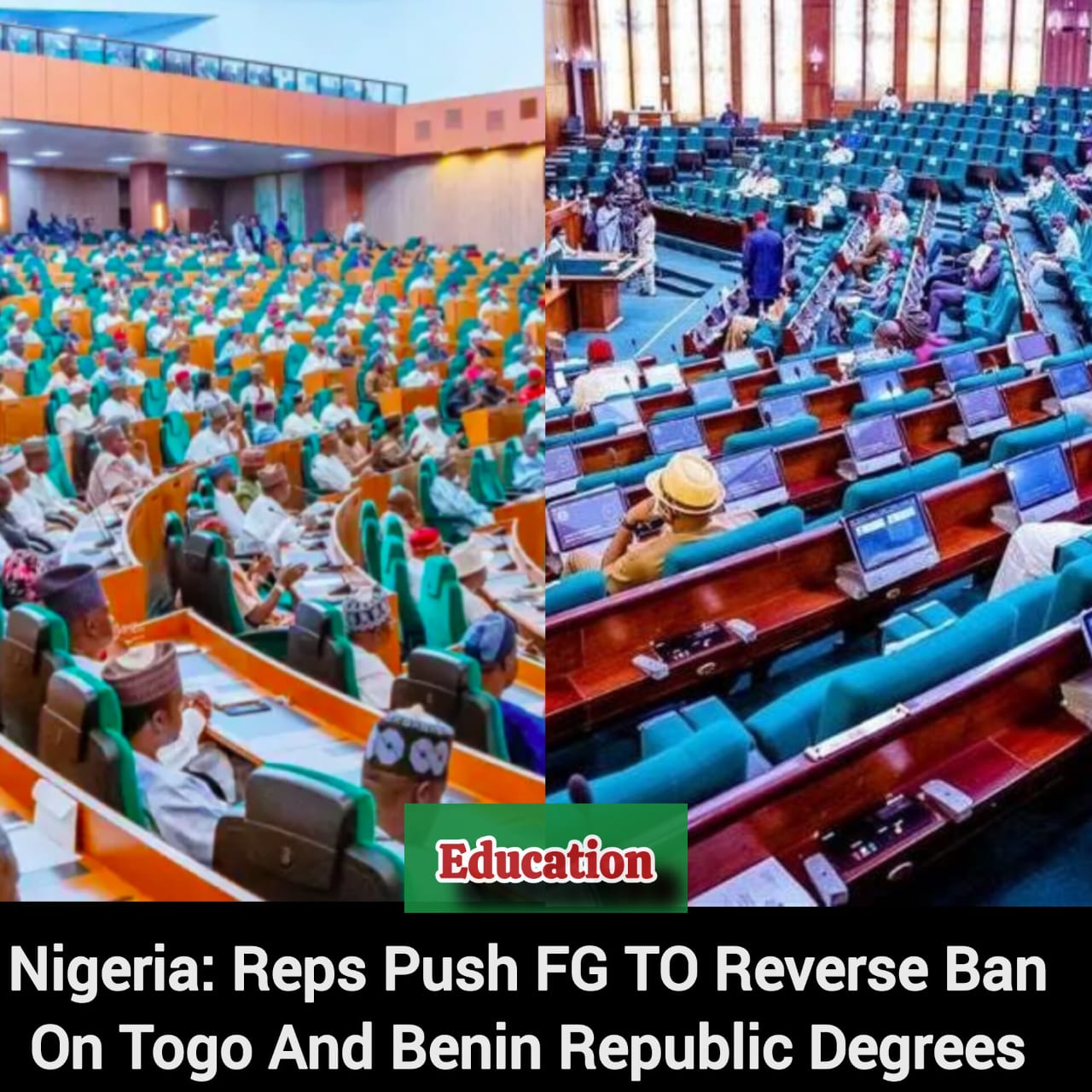
Nigeria’s reps call to reverse the blanket ban on degrees from the Benin Republic and Togo. Here’s what the policy means for graduates and what should happen next.
Nigeria’s House of Representatives has taken a firm stance on one of the most pressing issues facing the country’s education sector.
On 12 March 2026, lawmakers formally called on the Federal Government to reverse its blanket invalidation of degree certificates obtained from the Republic of Benin and Togo. This decision has left thousands of graduates in professional limbo.
The motion, which followed the adoption of a report by the House Committee on Public Petitions, was triggered by a petition from Sovereignty Legal Practitioners, acting on behalf of stakeholders in the education sector.
At its core, the debate raises a question that cuts to the heart of educational policy: when fraud is the problem, is punishing everyone really the solution?
Background: Why the Ban Was Introduced
The Federal Government’s decision to suspend the accreditation and evaluation of degrees from the Benin Republic and Togo was not made lightly.
In January 2024, an undercover investigation exposed widespread certificate racketeering involving institutions in both countries. The findings were alarming — a sophisticated network of fraudulent qualifications making their way into Nigeria’s workforce and public service.
The government’s response was swift. All degree certificates from both countries were invalidated pending further review. On the surface, the policy seemed decisive. In practice, it created an enormous problem for graduates who had earned their qualifications honestly.
READ ALSO: Dating A Short Man Feels Like I Am Dating My Son— Diminutive Ghanaian Woman (Video)
The Case Against a Blanket Ban
Committee Chairman Laori Kwamoti presented the committee’s findings clearly: a blanket ban, however well-intentioned, is a blunt instrument. It makes no distinction between a legitimate graduate who spent years studying abroad and someone who purchased a certificate from a diploma mill.
The consequences for those caught in the crossfire are significant. Affected graduates may find themselves locked out of employment, unable to have their qualifications recognised by Nigerian employers or professional bodies — despite having done nothing wrong. Their academic records are effectively rendered worthless by a policy designed to catch fraudsters, not them.
This is the core problem with sweeping sanctions in education policy. A minority usually commits fraud. When the penalty falls on everyone, the policy punishes the many for the actions of the few.
What the House of Representatives Is Recommending
Rather than maintaining the blanket ban, the House Committee on Public Petitions has proposed a more measured approach. Their key recommendations include:
- A case-by-case verification process to assess individual certificates on their own merits, rather than invalidating all degrees from both countries outright
- Collaboration between Nigeria’s Federal Ministry of Education and education authorities in Benin and Togo to strengthen cross-border verification systems and curb academic fraud
- Proper authentication frameworks for foreign qualifications, ensuring that legitimate degrees are recognized and fraudulent ones are identified and rejected.
These recommendations reflect a more proportionate approach — one that targets the actual problem without collateral damage to innocent graduates.
Why Verification Matters More Than Prohibition
The recommendations put forward by the House point to a broader truth about how countries should manage foreign qualifications. Outright bans are rarely sustainable long-term solutions. They disrupt legitimate academic pathways, deter genuine students from pursuing regional education opportunities, and create uncertainty for employers trying to assess candidates’ credentials.
A robust, case-by-case verification system, by contrast, addresses the root cause. It creates accountability without penalising those who played by the rules. Countries such as the United Kingdom and Canada have well-established frameworks for assessing foreign qualification systems that are thorough, fair, and adaptable as circumstances change.
For Nigeria, building a similar infrastructure would require investment and inter-agency cooperation. But the long-term benefits of a more trustworthy credentialing system and greater regional educational integration within West Africa far outweigh the short-term administrative effort.
The Bigger Picture: Academic Fraud in West Africa
Certificate racketeering is not unique to the Benin Republic and Togo. Across West Africa, the demand for qualifications, particularly among those seeking public sector employment, has fuelled a black market for fraudulent academic credentials.
The consequences extend beyond individual fraud; they undermine public trust in educational institutions and erode the credibility of legitimate qualifications.
Nigeria has grappled with this issue domestically as well. Degree mills and certificate forgeries have been a persistent challenge for regulatory bodies such as the National Universities Commission (NUC).
Addressing the problem at a regional level requires sustained collaboration, not unilateral bans that strain diplomatic and educational ties with neighbouring countries.
What Happens Next?
The House of Representatives’ recommendations are now before the Federal Government. Whether the government will act and how quickly remains to be seen. The Ministry of Education will need to engage with its counterparts in the Benin Republic and Togo to establish the verification frameworks that the committee has recommended.
For the thousands of graduates currently affected by the ban, the outcome of these deliberations is anything but abstract. Their careers, professional registrations, and livelihoods depend on a resolution that is both fair and effective.
A Smarter Path Forward
The House of Representatives is right to push back on the blanket ban. Fraud demands a targeted response, one that identifies bad actors rather than penalising entire cohorts of graduates who studied in good faith.
Building better verification systems will take time and political will. But it is the only approach that protects the integrity of Nigeria’s education system without sacrificing fairness.
As the Federal Government considers its next steps, the voices of affected graduates and the lawmakers advocating on their behalf deserve to be heard.
Health
Meet Turritopsis Dohrnii, “Immortal Jellyfish” That Can Reverse In Age, Likely To Live Forever, New Research


The human desire for immortality has long been a millennial human obsession. Humans have dabbled in all kinds of directions, from the mystic dimensions of religion to the science of cryogenics and even the fountain of youth.

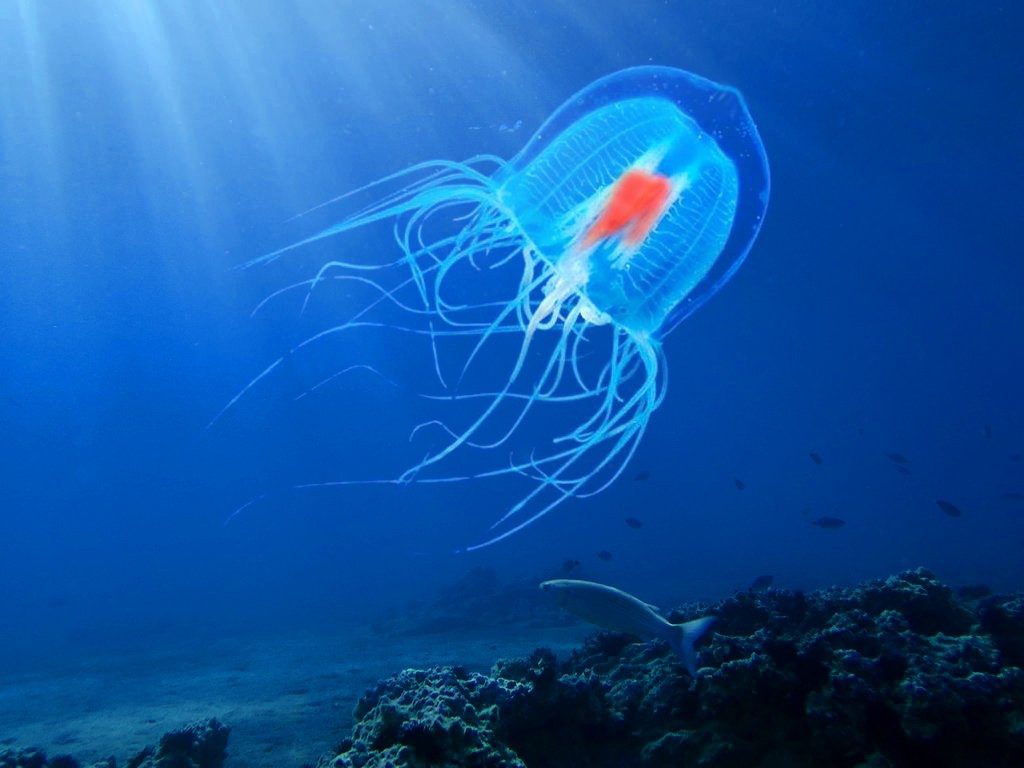
Yet, it turns out, the trick to avoiding death may have been sitting in plain sight—or, more precisely, lying under the waves. Meet the Turritopsis dohrnii—the “immortal jellyfish”—who has an incredible capacity to undo its ageing and still not die.
The life cycle of the immortal jellyfish is similar to any other jellyfish, at least in normal circumstances.
It starts as a larva, grows into a polyp (an unspinning, nonmoving object resembling something like a miniature anemone), and then develops into the adult medusa.
However, given environmental stress or injury, this jellyfish returns to a previous phase of its life cycle, turning its adult cells back into polyp (young) cells. Courtesy of the Natural History Museum.
This morphology is referred to as “transdifferentiation” and gives the jellyfish the opportunity to restart its life cycle. By doing so, the jellyfish’s specialised cells convert into more generalised, unspecialised cells that can turn themselves back into new cell types and rebuild the body to its youthful, polyp-like state.
After a jellyfish has become a polyp, its life cycle is essentially restarted. This way, it can develop into a fully grown medusa once again and not die of old age.
Ideally, this back-and-forth and re-growth can occur at any time so that the jellyfish can “evade” natural ageing.
The animal was first described by scientists in 1883, but it would take 100 years for scientists to stumble across its perpetual life cycle while preserving it in captivity.
The jellyfish, first found in the Mediterranean and now found in oceans across the world, is tiny, typically only 4-5 millimeters across, about the size of a pinky nail.
Although immortal in principle, Turritopsis dohrnii is far from unbreakable.
In the wild, it is under pressure, as are all marine animals, from predation, disease, and natural threats. Although it can biologically “start over” forever, many people die before they are able to exploit this gift to extend their lifespan dramatically.
But it’s a phenomenon that’s kept scientists intrigued and eager to discover how it keeps going. Researchers are looking to see if we could learn more about the jellyfish’s molecular dynamics in order to improve anti-ageing, cancer, and regenerative medicine.
For instance, the ability to safely “reprogram” human cells could lead to therapies for healing damaged tissue or even slowing down ageing.
Watch the video below, courtesy of National History Museum


Georgina Cooper, a British supermodel, died suddenly at the age of 46 on a Greek island two months after her wedding.


The mother of one fell unwell while on Kos with her new husband, Nigel. She was initially transferred to the island’s central hospital, but due to her terrible condition, physicians arranged for an air ambulance to transport her to Crete, which has better facilities.
Staff transported her to intensive care, where she died five days later. Her body was transferred back to England last week.
Her former agent, Dean Goodman, told MailOnline today, Nov. 8, “She loved Greece and told me that she was going back with her new husband—but she tragically died there a fortnight ago.”
“Georgina had become ill during COVID, developed some health issues, and had been in and out of the hospital. However, she had plans for the future. She had recently married and was looking forward to her life. Everyone is devastated. “She was a genuine superstar.”


A modelling agency discovered Georgina at the age of 13, and her first big break came when she appeared in a Bon Jovi music video when she was 15.
She was then branded London’s “original gap-toothed girl” and became one of the faces of the 1990s. She worked with the biggest names in fashion and was featured on the covers of US Vogue and The Face.
Georgina left the catwalk to focus on raising her son, Sonny. She recently worked in hospitality in Kent.
Georgina walked down the aisle near her house in Maidstone, Kent, with a reception at the local pub in early June 2024.
The couple subsequently honeymooned in Kos, where they posted a collection of joyous photos from their wedding on the island’s Facebook page.
However, she had returned to the Greek island at the end of October but had “tragically died” there after suffering from health problems throughout the pandemic, Dean Goodman stated.
Fellow catwalk talents Jade Parfitt, Erin O’Connor, Jodie Kidd, and Helena Christensen have paid tribute, calling her a “ray of light” with “colossal achievements in the industry.”
Jade Parfitt, a friend, and fellow model told MailOnline: “Her friends and family are absolutely devastated; Georgina was a ray of light, a prevalent model who was always laughing and being naughty in all the best ways.” Everyone wanted to spend time with George backstage. Her achievements in the sector were enormous.”


Download Blood Sisters Season 2 (Complete)

Download Michael (2026)

President Tinubu Confers National Honours on 50 Pro-Democracy Figures

Download Wura Season 4 (Episode 25 Added)

Download Behind the Scenes (2025) – Nollywood Movie

Nigeria: Reps Push FG to Reverse Ban on Togo, Benin Republic Degrees

Samsung Galaxy S26 Update Removes Perplexity’s ‘Hey Plex’ Voice Command

Galaxy Buds 4 Introduce AI‑Enhanced HD Voice to Transform Call Quality

Caviar Unveils 24K Gold Samsung Galaxy S26 Ultra For $11,490, Limited To Just 76 Buyers.

Orí: Rebirth (2025) – Nollywood-Yoruba-Movie


MC Oluomo Is No Longer A Valid NURTW Member; Tinubu Should Call Him To Order—Lekan Salami


Close President Putin’s Ally, Vladimir Egorov Plunges To Death From Third-Floor Window


”I Entrusted $9 Billion To Dauda Lawal, The Then FBN Executive Director. I Need To Seek Forgiveness From The Nigerian People And President Tinubu”-Diezani


”We Endorsed APC Muslim-Muslim Ticket In 2023, But Now We’re Suffering. What We Used To Buy N200 Now N2000”.- Supreme Council For Sharia Cries Out Over Hardship


”Sim Fubara Has Been Castrated, Now a Puppet Governor”-Nigerians Reacts Over Peace Deal With Predecessor, Nyesom Wike

Yahaya Bello Visited Our Office In A Convoy With The Sitting Governor- EFCC Revealed Why He Was Turned Back


Dele Momodu Pins Blame On President Tinubu Amidst the Protests


Reinstated Kano Emir Muhammadu Sanusi Gets Another Court Removal Verdict

Resurfaced 1995 Video Of Kamala Harris And Willie Brown Sparks Reactions


Our Economy Is Recovering Steadily And Gradually- President Tinubu Tells Traditional Rulers.
Watch This Blogger Home Is An Airy Inspiration
Hipster Yoga at the End of the World

Illinois’ financial crisis could bring the state to a halt
The final 6 ‘Game of Thrones’ episodes might feel like a full season
New Season 8 Walking Dead trailer flashes forward in time
Mod turns ‘Counter-Strike’ into a ‘Tekken’ clone with fighting chickens
Meet Superman’s grandfather in new trailer for Krypton
Disney’s live-action Aladdin finally finds its stars
Who are the early favorites to win the NFL rushing title?
The old and New Edition cast comes together to perform
-
News2 years ago
MC Oluomo Is No Longer A Valid NURTW Member; Tinubu Should Call Him To Order—Lekan Salami
-
Viral Gists2 years ago
Close President Putin’s Ally, Vladimir Egorov Plunges To Death From Third-Floor Window
-
Viral Gists2 years ago
”I Entrusted $9 Billion To Dauda Lawal, The Then FBN Executive Director. I Need To Seek Forgiveness From The Nigerian People And President Tinubu”-Diezani
-
Viral Gists2 years ago
”We Endorsed APC Muslim-Muslim Ticket In 2023, But Now We’re Suffering. What We Used To Buy N200 Now N2000”.- Supreme Council For Sharia Cries Out Over Hardship
-
Viral Gists3 years ago
”Sim Fubara Has Been Castrated, Now a Puppet Governor”-Nigerians Reacts Over Peace Deal With Predecessor, Nyesom Wike
-
Politics2 years ago
Yahaya Bello Visited Our Office In A Convoy With The Sitting Governor- EFCC Revealed Why He Was Turned Back
-
News2 years ago
Dele Momodu Pins Blame On President Tinubu Amidst the Protests
-
Viral Gists2 years ago
Reinstated Kano Emir Muhammadu Sanusi Gets Another Court Removal Verdict


